
Who Eats the First Loss
A tranche is a slice of a pooled investment with its own place in line. The junior slice takes losses first. The senior slice is paid first from what remains. In traditional finance that promise has a strong record. Through the end of 2025, S&P had recorded no default by a U.S. or European broadly syndicated loan CLO tranche that was originally rated AAA.1 An academic study separately counted 1,250 AAA tranches issued from 1997 to 2009 and 4,779 issued from 2010 to 2019. None had defaulted by March 2021.2
DeFi borrowed the same words: senior, junior, first loss, protected. We reviewed the disclosed incidents we could verify and asked a narrower question: when a loss was finally allocated, did the junior layer absorb it and leave the senior claim whole without outside help?
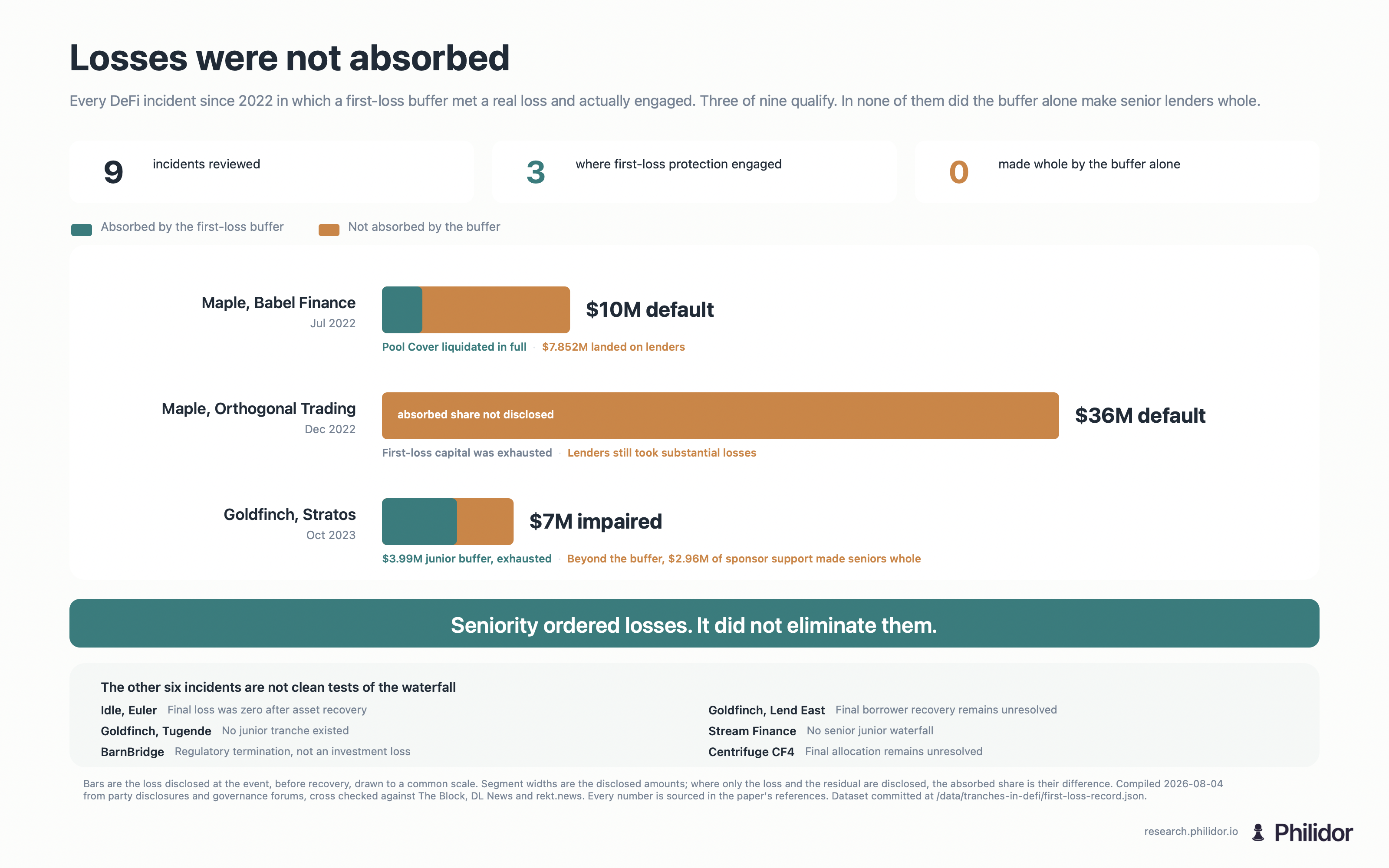
The current record contains nine source-qualified cases, but they are not nine comparable loss tests. Three document an executed loss allocation: Maple's Babel and Orthogonal Trading defaults, and Goldfinch's Stratos pool. Lend East is a fourth, provisional case because the cited amount was an expected repayment, not a verified payment. Idle ended with zero loss. Tugende and Stream had no junior layer to test. BarnBridge was a regulatory shutdown. Centrifuge's CF4 outcome remains unresolved.
Across the executed cases, we found no instance in which the junior layer alone covered the full loss. Maple's cover reduced lender losses but did not eliminate them. At Stratos, the repayment waterfall sent recovered cash to the senior pool first, then a sponsor paid the remaining senior shortfall and separately backstopped eligible junior investors. The structure mattered, but it was not sufficient by itself.
This distinction matters for risk scoring. A loss waterfall can be useful without being complete protection. The claim should be priced from what is locked in front of it, which loss types the priority covers, and which outside promises are legally separate from the structure.
The Record, Event by Event
Maple, Babel Finance, July 2022. Babel defaulted on a $10M USDC loan in an Orthogonal pool. Orthogonal added $1M to Pool Cover before the default, and the maximum available cover was liquidated. A remaining $7.852M loss was spread across lenders, equal to about 3.2 percent of the pool.3 The buffer worked, but only partially.
Maple, Orthogonal Trading, December 2022. Orthogonal Trading then defaulted on $36M across eight M11 Credit loans: $31M in the USDC pool and $5M in the wETH pool.4 The first-loss balances were more complicated than the headline default number suggests. The USDC pool liquidated 463,650 USDC from M11 and another 151,933 USDC from Maple Treasury. The wETH pool liquidated 56.64 wETH from M11 and 7.6 wETH from another provider. The MPL withdrawn from the old Pool Cover contracts was airdropped to affected lenders; it was not liquidated as first-loss capital.5
The widely cited $2.5M estimate combined Pool Cover and accrued fees. The source does not allocate it cleanly between the two pools or identify it all as junior capital. Dividing $2.5M by the $31M USDC exposure therefore does not produce a defensible junior-coverage ratio. The safe conclusion is only that first-loss capital was exhausted and lenders still took substantial losses.
Euler exploit through Idle, March 2023. Idle's senior tranche had a first claim on remaining assets after a default, hack or loss of funds. Euler was exploited for about $197M, and roughly $5.8M of Idle funds across Yield Tranches and Best Yield were temporarily locked.67 The attacker returned the assets three weeks later and Idle restored both tranches in full.8
This was a serious stress event, but not a failed waterfall. Idle's rules say that, after a partial loss, remaining assets are distributed to senior holders first.9 Because the final loss was zero, that allocation was never tested.
Goldfinch, Tugende, 2023-2024. Tugende is useful as a no-junior comparison, not as a tranche test. The $5M facility was made before Goldfinch introduced tranched pools and had zero Backers. After an unauthorized $1.9M intercompany loan, the disclosed worst case was a 3.95 percent write-down of Senior Pool NAV.1011 The community supplied a $1M payment in 2023. A completed restructuring later returned another $460,000 directly to the Senior Pool in December 2024, including $250,000 of loan recovery and $210,000 of closing fees.1213
Goldfinch, Stratos, October-December 2023. The $20M Stratos pool had about $15.96M from the Senior Pool and $3.99M from Backers. Two positions totaling $7M were expected to be written off.1411 The later cash flows show that the tranche structure did matter. A $13.04M pool repayment went entirely to Senior Pool principal. Warbler Labs then provided about $2.96M to complete senior repayment and separately backstopped eligible Backers.15 The correct reading is mixed: the waterfall gave seniors priority over recovered cash, while the sponsor covered the shortfall the junior layer could not absorb.
Goldfinch, Lend East, from April 2024. Lend East told Warbler Labs that it expected to repay only about $4.25M of its $10.15M pool. The same forum thread later said Lend East had the $4.25M but was withholding it while seeking a settlement.16 That source does not prove that $4.25M was paid, so this row is recorded as an expected repayment rather than a verified one.
The capital stack was $8.12M senior and $2.03M junior. If the proposed repayment were final, the implied $5.9M shortfall would wipe the junior layer and reach senior investors.11 A separate GFI-funded backstop paid $759,585.89 to the Senior Pool and $398,439.11 to Backers in January 2025.17 The final borrower recovery was not established in the sources reviewed here, so this remains a provisional loss case.
BarnBridge, December 2023. BarnBridge was one of DeFi's earliest explicit tranche projects, but not the first live one: Saffron released a Compound tranching mechanism in October 2020, while BarnBridge's SMART Yield junior program launched in March 2021.1819 BarnBridge ended for regulatory reasons. The SEC said more than $509M had been invested in SMART Yield, ordered nearly $1.5M of disgorgement and imposed two $125,000 civil penalties.20 Those payments are not losses allocated through a waterfall and do not belong in a loss total.
Stream Finance contagion, November 2025. Stream disclosed a $93M loss at an external fund manager and halted withdrawals.21 An early analyst map estimated about $285M of related debt exposure across at least seven networks. The source called the map incomplete and the amount potential exposure; it did not call $285M realized loss.22 Because the positions were rehypothecated, gross claims may also overlap. Stream is an important comparison for vault risk, but the connected vaults did not offer a senior/junior capital stack. It is not evidence that a tranche waterfall failed.
Centrifuge CF4, unresolved. Tinlake's CF4 pool disclosed DAI 1,792,471 of exposure to a borrower that had entered court-ordered liquidation. The issuer held more than 54 percent of the junior TIN tokens. A community post alleged that roughly 180,000 DAI of TIN was withdrawn after notice of the liquidation.23 We did not find a final allocation of loss between TIN and DROP. The exposure is verified; the withdrawal remains an allegation; the senior outcome is unresolved.
The records are comparable by category, not by one dollar total.
| Record | Category | Amount that can be stated safely | Waterfall result |
|---|---|---|---|
| Maple, Babel | Realized default | $10M default; $7.852M remained for lenders | Cover reduced, but did not eliminate, lender loss |
| Maple, Orthogonal Trading | Realized default | $36M default across USDC and wETH pools | First-loss capital exhausted; lenders lost money |
| Idle through Euler | Zero-final-loss stress event | $5.8M temporarily locked; $0 final Idle loss | Not tested by a final loss |
| Goldfinch, Tugende | No-junior comparison | $5M facility; later $1M support and $460k recovery | No borrower-pool waterfall existed |
| Goldfinch, Stratos | Realized impairment and recovery | $7M impaired; $13.04M recovery plus $2.96M senior support | Senior priority operated; sponsor filled the gap |
| Goldfinch, Lend East | Provisional loss | $5.9M implied shortfall, not certified final loss | Would exceed junior; final recovery unresolved |
| BarnBridge | Regulatory termination | >$509M invested; about $1.75M settlement payments | Not a loss-allocation event |
| Stream and connected debt | Untranched comparison | $93M disclosed loss; about $285M gross debt exposure | No senior/junior waterfall existed |
| Centrifuge CF4 | Unresolved tranche case | DAI 1.792M exposure | Final allocation not found |
Four Designs, Not One Straight Line
The first wave built explicit tranches. Saffron released a Compound tranching mechanism in October 2020. BarnBridge followed with SMART Yield in 2021. Idle wrote a senior first lien that included hacks and loss of funds, not only borrower default.181924 Centrifuge's Tinlake enforced a maximum senior ratio, which implicitly set a minimum junior share as a hard pool constraint.25
Those legacy products later became small or closed, but low deposits do not prove that the structure itself failed. Around the article's 20 July 2026 snapshot, DeFiLlama showed roughly $1.4M in Idle and $2.1M in Goldfinch; Centrifuge's roughly $1.63B belonged to later product generations rather than Tinlake.26 BarnBridge ended after the SEC settlement. Idle's contracts remain documented and active with a small balance, so "shrunk" is more accurate than "wound down."
A second design attached first-loss capital to delegated lending. Maple pool delegates posted cover. Goldfinch Backers funded junior capital below a shared Senior Pool, and repayments were applied to senior principal first.27 The live ratios were not necessarily derived from a common stress model. Goldfinch governance, for example, allowed a 0x Senior Pool leverage ratio when senior liquidity was scarce, creating Backer-only pools.28
A third design, prominent in 2024 and 2025, used curator vaults without a ranked capital stack. The curator chose markets and caps, while the documented role imposed no first-loss capital requirement.29 Loss accounting is also version-specific. Morpho Vault V1.0 and V2 can socialize realized losses across shares, while V1.1 does not realize bad debt internally and can leave the last depositor with the loss in a bank-run scenario.3031 A blanket claim that every Morpho vault shares bad debt immediately and pro rata is therefore incorrect. These vaults generally do not claim seniority; they are a comparison for pooled curation risk, not failed tranches.
A fourth design is now bringing junior capital back. DefiLlama Research's July 2026 survey identifies live buffers or tranches at Avant, Strata, Yuzu, Royco, 3Jane and infiniFi, with reported loss-absorption thresholds varying materially by design.32 A separate market estimate still puts tranching below one percent of DeFi lending deposits, so the cohort is early, not absent.33
Pendle is a separate case. It splits principal and yield cash flows, not first loss between credit tranches.34 Counting it as proof of credit subordination would mix two different products.
What the CLO Record Actually Proves
The scoreboard DeFi borrows is real, but subordination did not produce it alone. A leveraged-loan CLO combines a diversified portfolio, senior secured collateral, active management, coverage tests, reinvestment rules and a contractual waterfall. The whole package protects senior notes.
The academic study behind the zero-default headline also shows losses lower in the stack. Through March 2021, CLO 1.0 tranches issued from 1997 to 2009 defaulted at 0.30 percent for A, 1.62 percent for BBB and 3.40 percent for BB, while the 1,250 AAA and 531 AA observations had zero defaults.2 That AA statement must be time-bounded: S&P's broader record through 2025 includes one originally AA CLO 1.0 default, while originally AAA U.S. and European broadly syndicated loan CLO tranches remain at zero.1
The machinery that produced it is documented and dull. The Bank of England found that tranches rated BBB and above in a representative 2018 CLO would take no losses in a repeat of the financial crisis, and that touching AAA would take a loss rate more than twice as severe. It also recorded the caveat that matters for anyone quoting the record. AAA tranches still fell about 20 percent in market value in 2008 while meeting almost all of their scheduled cash flows.35 The FSB documents the rest. Coverage tests divert cash from the equity and mezzanine slices to pay seniors down when collateral quality slips, and reverse stress tests require historically unprecedented default rates before AAA principal is reached.36
Time helps CLO coverage tests redirect cash and managers work through defaults. It is not a prerequisite for a waterfall to allocate a sudden loss. Idle's contracts, for example, specify that whatever assets remain after a hack are distributed to senior holders first.9 A fast loss instead creates different problems: whether the contracts pause, whether junior capital can withdraw, how the loss is recognized, and whether the buffer was sized for an exploit rather than ordinary borrower default.
The senior CLO investor also pays for the protection in yield. Measured as a premium over a matched benchmark, the AAA slice earns about half a percent of extra annual return while the riskiest rated slice, B, earns 2.3 percent.2 That spread is compensation within a larger structure; it should not be read as the price of subordination alone.
Two Disclosures That Make Seniority Legible
The useful measures are simpler than the debate around them suggests. Parts of the market already publish some of this information, but the disclosure is not consistent.
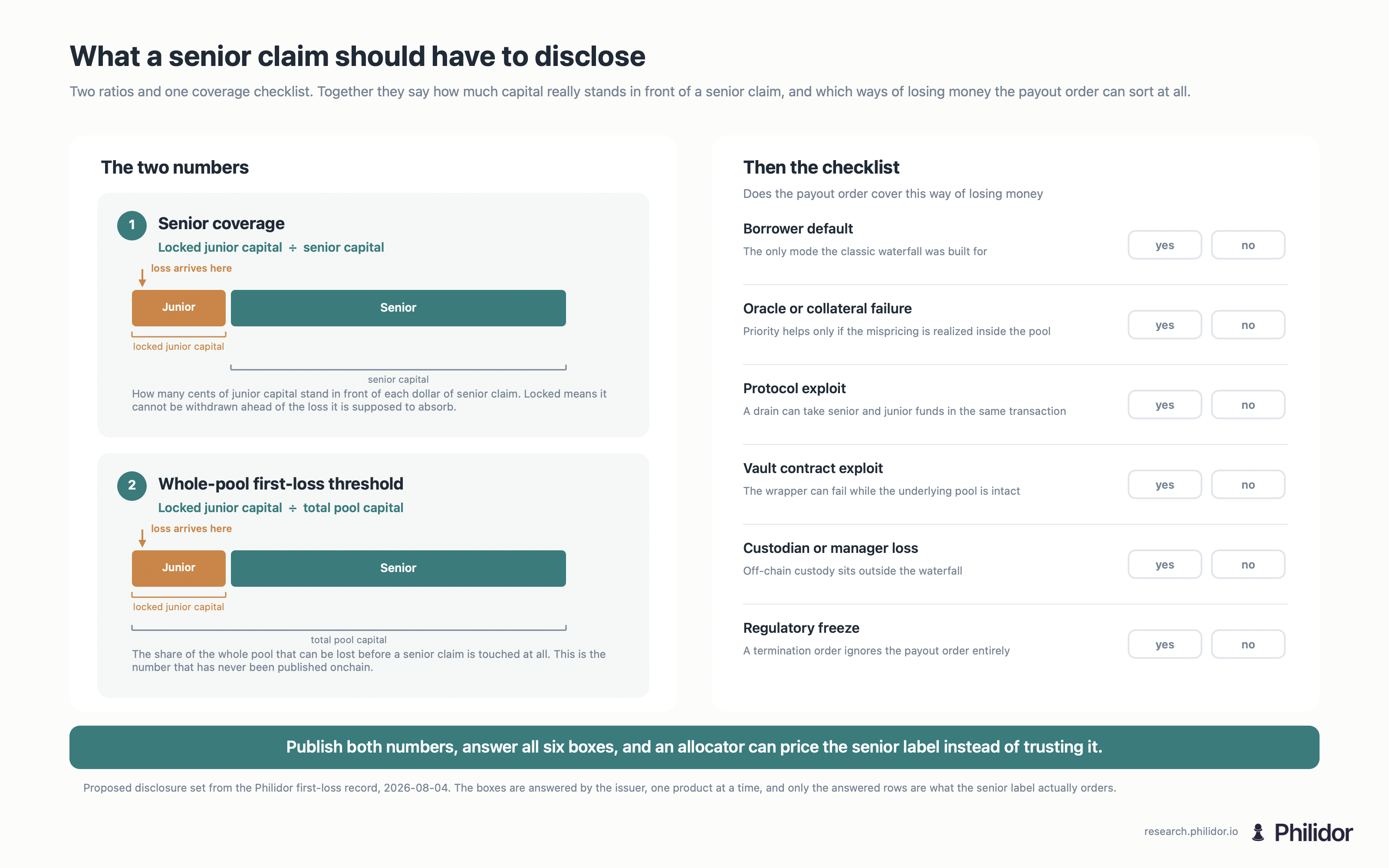
1. Locked junior buffer. Start with two balances:
- Senior coverage = locked junior capital / senior capital.
- Whole-pool first-loss threshold = locked junior capital / total pool capital.
The first number answers, "How many junior dollars stand in front of each senior dollar?" The second answers, "How much can the whole pool lose before senior principal is touched?" Idle's documentation already publishes the first formula as junior liquidity divided by senior liquidity.37
"Locked" is the important word. The calculation should include only capital that cannot leave ahead of senior investors after bad news. A protocol should publish the live ratio, the ratio after the largest withdrawal currently allowed, the withdrawal delay and who can change those rules.
Stratos shows how to read the result. About $3.99M of junior capital sat below $15.96M of senior capital. That was roughly 25 cents of junior capital per senior dollar, or a 20 percent first-loss threshold for the whole pool. A $7M impairment exceeded that buffer. The waterfall still gave seniors priority, but an external payment was required to make them whole.
Maple's December 2022 event should not be used for this calculation until the cover is reconciled pool by pool. The public $2.5M estimate combined cover and fees across USDC and wETH exposures. Treating all of it as junior capital for the $31M USDC pool creates a ratio the cited sources do not support.
2. Protection scope. Publish a short table showing whether senior priority applies to each material loss scenario:
| Loss scenario | Senior priority applies? | How the loss is recognized |
|---|---|---|
| Borrower default | Yes / no / conditional | Contract and trigger |
| Collateral or oracle failure | Yes / no / conditional | Contract and trigger |
| Strategy or protocol exploit | Yes / no / conditional | Contract and trigger |
| Vault-contract exploit | Yes / no / conditional | Contract and trigger |
| Custodian or manager loss | Yes / no / conditional | Legal claim and trigger |
| Regulatory or legal freeze | Yes / no / conditional | Legal claim and trigger |
This is more honest than a single "ordered-loss share." Any such score divides unlike amounts from a small, selected sample, and it is not a market loss distribution. A protocol can turn protection scope into one percentage only if it publishes the stress model and the scenario weights behind it.
Together, these disclosures answer the two questions an allocator actually has: how much capital absorbs losses before mine, and under which events does that priority work?
Early, Small, and Worth Building Right
The disclosed record is small and selected by what became public. It cannot estimate a market-wide failure rate, and it says little about small losses that a junior layer may have absorbed quietly.
It does show that the necessary parts can be built onchain. Tinlake enforced a minimum junior share as a contract constraint. Idle encoded senior priority for hacks, although Euler ended with zero final loss and did not test it. Goldfinch's Stratos waterfall directed $13.04M of recovered cash to senior principal before Backers. Maple liquidated Pool Cover in the Babel and Orthogonal Trading defaults. The new 2026 cohort is experimenting with the same parts again.
The next step is to combine them with explicit sizing, withdrawal controls and loss definitions. A product does not need to promise that senior capital can never lose. It needs to show exactly what stands in front of that capital and when the priority applies.
Background and Prior Work
The theory gives a clear warning. Coval, Jurek and Stafford show that many structured-finance claims resemble economic catastrophe bonds: they default in the states where losses are most costly and may offer too little compensation for that exposure.38 Gennaioli, Shleifer and Vishny explain how intermediaries can create securities that look safe because investors neglect unlikely risks.39
The DeFi literature covers the pieces. Early investor research described onchain tranching as securitized cash-flow splitting.40 Nadler, Bekemeier and Schär proposed a CDO-inspired design in which the junior tranche absorbs technical failures first.41 The BIS explains why most pseudonymous DeFi lending instead relies on overcollateralization.42 More recent work maps risk moving into curator vaults and argues for stronger disclosure or standardized ratings.434445
Our contribution is narrower than a claim of being the first paper to study the topic. We assemble a source-qualified incident review, separate actual waterfall tests from comparison cases, and turn the gaps into two concrete disclosures.
How We Built the Record
This is a targeted disclosed-event review, not a complete census. We searched protocol disclosures, governance forums, regulator releases, post-mortems and corroborating journalism. Maple's July 2022 Babel default surfaced only after a second search pass, which is why the paper cannot claim that its ledger contains every qualifying event.
The record separates five categories:
- realized losses in a live first-loss or senior/junior structure;
- provisional or unresolved tranche cases;
- stress events that ended with zero final loss;
- comparison cases with no junior layer; and
- non-loss terminations.
One row represents one disclosed structure or comparison case. Goldfinch's deals remain separate because each pool had its own capital stack. Stream is one comparison case because the disclosed loss originated at one manager and the connected vaults had no senior/junior waterfall to test. Pendle-style principal/yield splitting remains out of scope.
The dataset records each amount according to what the source actually measures: defaulted principal, impaired positions, temporary funds locked, cash recovery, regulatory payments, disclosed loss or gross exposure. A proposed repayment is not recorded as cash received, and gross debt exposure is not recorded as realized loss. Because those measures are not comparable, the paper does not sum them.
What Would Make This Wrong
Each of these is a measurement someone can run, and any one of them landing would change the paper's conclusions.
- A full-protection counterexample. One verified case in which junior capital absorbed a realized loss in full and seniors stayed whole through the structure alone would overturn the strongest finding.
- Another omitted case. The review is disclosure-driven. A qualifying event at Maple was missed once, so further omissions are plausible. A systematic protocol-by-protocol loss ledger could materially change the sample.
- Undisclosed loss-bearing capital. If curators or protocols carry private first-loss arrangements, side letters, insurance funds or standing buyback commitments, the documented buffer is incomplete. Those promises should be disclosed with their amount, priority and exit terms.
- Survivorship in the record. Small junior layers that quietly absorbed small losses may never have produced a disclosure to verify. Protocol-level loss ledgers would surface them.
- Resolved recovery data. Final borrower payments for Lend East or a closing allocation for CF4 could change those rows from provisional to executed outcomes.
What to Ask Before Buying the Senior Anything
An allocator reading a senior label onchain can turn this record into five questions, all checkable before deposit.
- Which loss types does the waterfall order? Read the loss definition in the docs, not the tranche names. Check borrower default, collateral and oracle failure, exploits, manager loss and legal claims separately.
- How many dollars of junior capital stand in front of you today? Not a launch ratio: the current locked balance, the senior balance and the whole-pool first-loss threshold.
- Who can withdraw the junior, and how fast? Publish the ratio after the largest withdrawal the rules currently allow, plus any pause or queue.
- How is a loss recognized and allocated? A written promise of senior priority is useful only if the contracts or legal documents explain the trigger and the remaining-asset calculation.
- What depends on outside support? Separate contractual subordination from treasury grants, insurance, token sales and discretionary sponsor payments. Stratos used both a waterfall and a sponsor; they should not be described as the same protection.
For our own scoring, a vault that names a junior gets asked for the current locked balance, exit terms and protection scope. A claim with pro-rata loss sharing is scored as pooled exposure against those loss scenarios, whatever its marketing label.
Reproducibility
The public JSON record
contains the classifications, source-qualified amounts, outcomes and source
keys. The source repository bibliography at
docs/research/bibliographies/tranches-in-defi.md records titles, URLs,
fetch dates, excerpts and archive links. DeFiLlama TVLs retain
their stated 20 July 2026 snapshot rather than being presented as live data.
References
-
S&P Global Ratings (2026). Default, Transition, and Recovery: 2025 Annual Global Leveraged Loan CLO Default And Rating Transition Study. Data through 31 December 2025. ↩ ↩2
-
Cordell, L., Roberts, M. R. & Schwert, M. (2021). CLO Performance. Federal Reserve Bank of Philadelphia Working Paper 20-48; Journal of Finance 78(3), 2023. ↩ ↩2 ↩3
-
Orthogonal Credit (2022). Confidently Moving Forward from Babel Loan Liquidation. Medium. ↩
-
The Block (2022). Orthogonal Trading defaults on $36 million of loans on Maple Finance. ↩
-
M11 Credit (2022). M11 Credit Update on Orthogonal Trading. Medium. ↩
-
Bentley, M., Euler Labs (2024). War & Peace: Behind the Scenes of Euler's $240M Exploit Recovery. euler.finance blog. ↩
-
Idle DAO (2023). Euler Incident Analysis & Exposure Breakdown. Medium. ↩
-
Idle DAO (2023). Euler Incident: Full Recovery & Distribution Plan. Medium. ↩
-
Idle DAO (2026). Yield Tranches: Edge Cases. Accessed 2026-08-04. ↩ ↩2
-
Warbler Labs (2023). Update on the Tugende Kenya Facility. Goldfinch Governance Forum. ↩
-
Warbler Labs (2023). Warbler's First Community Risk Review: capital by tranche. Goldfinch Governance Forum. ↩ ↩2 ↩3
-
Warbler Labs (2023). GIP-52: Tugende Response Plan. Goldfinch Governance Forum. ↩
-
Sall, M., Warbler Labs (2024). Tugende restructuring completed with a $460,000 recovery. Goldfinch Governance Forum. ↩
-
Sall, M. & West, B., Warbler Labs (2023). Update on Stratos Pool. Goldfinch Governance Forum. ↩
-
Goldfinch (2023). Stratos technical changes to support re-finance and Warbler Backstop. Goldfinch Governance Forum. ↩
-
Warbler Labs (2024). Update on Lend East Pool. Goldfinch Governance Forum. ↩
-
West, B. (2025). GIP-67: Lend East backstop payment update. Goldfinch Governance Forum. ↩
-
Saffron Finance (2026). Saffron History. Accessed 2026-08-04. ↩ ↩2
-
BarnBridge (archived). BarnBridge FAQ. Accessed 2026-08-04. ↩ ↩2
-
U.S. Securities and Exchange Commission (2023). BarnBridge DAO Agrees to Stop Unregistered Offer and Sale of Structured Finance Crypto Product. SEC press release 2023-258. ↩
-
Shen, T., The Block (2025). Stream Finance halts withdrawals and deposits after $93 million loss disclosed. ↩
-
Avan-Nomayo, N., The Block (2025). Analysts map $285M in potential exposure across DeFi after Stream Finance's $93M loss. ↩
-
ConsolFreight (2023). CF4-Pool Update August 2023 Important Notice. Centrifuge Governance Forum. ↩
-
Idle DAO (2026). Yield Tranches Overview. docs.idle.finance. Accessed 2026-07-20. ↩
-
Centrifuge (2026). Tinlake Smart Contracts, Legacy. docs.centrifuge.io. Accessed 2026-07-20. ↩
-
DeFiLlama (2026). Total DeFi TVL and per-protocol TVLs. api.llama.fi. Fetched 2026-07-20. ↩
-
Goldfinch Foundation (2026). Goldfinch Overview. docs.goldfinch.finance. Accessed 2026-07-20. ↩
-
Okwodu, O. & Collett, A. (2022). GIP-29: Unitranche pools. Goldfinch Governance Forum. ↩
-
Morpho (2026). Curator. docs.morpho.org. Accessed 2026-07-20. ↩
-
Morpho (2026). Handling Bad Debt: Morpho Vault V2. Accessed 2026-08-04. ↩
-
Morpho (2026). Security Considerations for Vault Curators. Accessed 2026-08-04. ↩
-
DeFiLlama Research (2026). Tranching in DeFi: Can the Junior Buffer Actually Survive an Exploit?. Published 10 July 2026. ↩
-
Crypto Briefing (2026). Onchain tranching is positioning itself as the future of structured finance in DeFi. Covering analysis by Silvio Busonero, Blockworks advisory. ↩
-
Pendle Finance (2026). Introduction, Pendle V2 docs. docs.pendle.finance. Accessed 2026-07-20. ↩
-
Bank of England Financial Policy Committee (2019). Financial Stability Report, July 2019. Bank of England. ↩
-
Financial Stability Board (2019). Vulnerabilities associated with leveraged loans and collateralised loan obligations. ↩
-
Idle DAO (2026). Adaptive Yield Split. Accessed 2026-08-04. ↩
-
Coval, J., Jurek, J. & Stafford, E. (2009). The Economics of Structured Finance. Journal of Economic Perspectives 23(1). ↩
-
Gennaioli, N., Shleifer, A. & Vishny, R. W. (2010). Neglected Risks, Financial Innovation, and Financial Fragility. NBER Working Paper 16068; Journal of Financial Economics (2012). ↩
-
Rai, R., Gamma Point Capital (2021). Fixed Income Protocols, The Next Wave of DeFi Innovation. Medium. ↩
-
Nadler, M., Bekemeier, F. & Schär, F. (2022). DeFi Risk Transfer: Towards A Fully Decentralized Insurance Protocol. arXiv 2212.10308. ↩
-
Aramonte, S., Doerr, S., Huang, W. & Schrimpf, A. (2022). DeFi lending: intermediation without information? BIS Bulletin No 57. ↩
-
Zbandut, A. & Goldstein, C. (2025). Institutionalizing risk curation in decentralized credit. arXiv 2512.11976. ↩
-
Benbrik, K. & Socolov, Y., Chorus One (2025). DeFi Curators in 2025: Navigating Chaos, Building Resilience. Chorus One reports and research. ↩
-
Sentora Research (2026). The Vault Economy. Sentora research reports. ↩